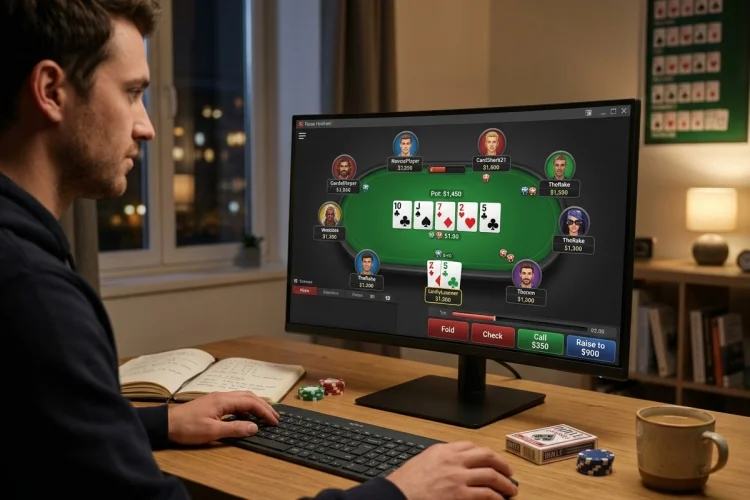
Online poker can appear complicated when a table is filled with unfamiliar buttons, betting amounts, timers, and players using terms such as blinds, flop, and river.
Once the basic structure is understood, however, the game becomes much easier to follow. Learning how to play online casino poker begins with recognizing that most poker rooms are different from ordinary casino games.
In slots or roulette, players compete against fixed game mathematics. In standard online Texas Hold’em, participants mainly compete against one another while the operator manages the table and may collect a fee known as rake.
This beginner’s guide focuses on player-versus-player Texas Hold’em rather than house-banked variations such as Three Card Poker. It explains hand rankings, betting rounds, table actions, playing formats, position, and bankroll control.
Poker contains both skill and chance, so good decisions can improve long-term performance, but they can never guarantee that a particular hand or session will be profitable.
Understand the Objective of Online Poker
The objective is to win the pot, which contains all chips wagered during a hand. You can win by holding the strongest five-card combination at showdown or by betting in a way that causes every opponent to fold.
In Texas Hold’em, each player receives two private cards. Five community cards are gradually placed on the table, and everyone can use them. Your final hand is the strongest five-card combination available from your two private cards and the five community cards.
Learn the Poker Hand Rankings
Before joining a table, memorize the standard poker hierarchy. From strongest to weakest, it is royal flush, straight flush, four of a kind, full house, flush, straight, three of a kind, two pair, one pair, and high card.
You do not always need to use both private cards. For example, if the community cards already form the best possible straight, your final hand may use all five board cards. When two players have the same category, kickers or additional card values can determine the winner.
Follow the Texas Hold’em Betting Rounds
1. Pre-Flop
Two players post mandatory bets called the small blind and big blind. Everyone then receives two private cards. Starting with the player to the left of the big blind, participants may fold, call, or raise.
2. Flop, Turn, and River
The flop introduces three community cards. The turn adds a fourth, and the river provides the fifth and final card. A new betting round usually occurs after each stage.
When the last betting round ends, the remaining players reveal their cards at showdown. The strongest valid five-card hand wins the pot, which is divided when identical hands tie.
Know the Main Poker Actions
To fold means surrendering your cards and leaving the current pot. You lose chips already committed but cannot lose more during that hand.
To check means passing the action without betting when no previous wager has been made. A call matches the current bet, while a raise increases it. An all-in action places all your remaining table chips into the pot.
Do not click too quickly simply because online tables use a decision timer. Read the previous action, current pot size, and amount required to call before choosing.
Choose Cash Games or Tournaments
In a cash game, chips represent their direct table value. Players can usually enter or leave between hands, subject to the platform’s minimum and maximum buy-ins.
A tournament charges an entry fee and gives participants a fixed number of tournament chips. Blinds rise according to a schedule, and players are eliminated after losing all their chips unless re-entry is permitted.
Beginners may find low-stakes cash tables easier for learning because blind levels remain stable. Small or free-play tournaments can also teach patience, changing stack sizes, and elimination pressure.
Online poker platforms may offer Texas Hold’em, Omaha, cash games, and multi-table tournaments.
Use Position to Make Better Decisions
Position describes where you act in relation to the dealer button. Players in later positions see what several opponents do before making a decision, giving them more information.
As a beginner, play fewer hands from early position because many opponents still have an opportunity to raise. You can consider a slightly wider selection from late position when earlier players have folded.
Position does not make weak cards automatically strong. It simply makes decisions easier because you have observed more table action.
Select Suitable Stakes and Manage Your Bankroll
Start at stakes where losing the entire buy-in would not affect essential expenses. A poker bankroll should be separate from rent, food, debt payments, savings, and emergency money.
Do not increase the stakes to recover a loss quickly. This behavior, often called chasing losses, can turn a controlled session into a much larger financial problem.
Set a deposit amount and session limit before opening a table. Safer-gambling resources recommend tools such as financial limits, breaks, and self-exclusion when greater control is required.
Choose a Legal and Reliable Poker Site
Use only a platform permitted in your jurisdiction and appropriate for your age. Check the operator’s licence, company name, official website address, payment terms, withdrawal rules, security features, and customer-support options.
Do not assume that a professional design proves legitimacy. Where available, search the relevant regulator’s public register and compare the listed domain with the website you are visiting.
Learning how to play online casino poker starts with understanding hand rankings, blinds, betting rounds, table actions, and the difference between cash games and tournaments.
Beginners should also recognize the value of position, choose starting hands carefully, and avoid risking excessive amounts.
Poker rewards thoughtful decisions, but short-term outcomes remain uncertain because the cards are randomly dealt. Begin with free-play or the smallest suitable stakes, study each decision, and review your results without chasing losses.
Before depositing, verify that the operator is legal and licensed for your location. Set firm spending and time limits, then treat every session as entertainment rather than a reliable way to earn money.