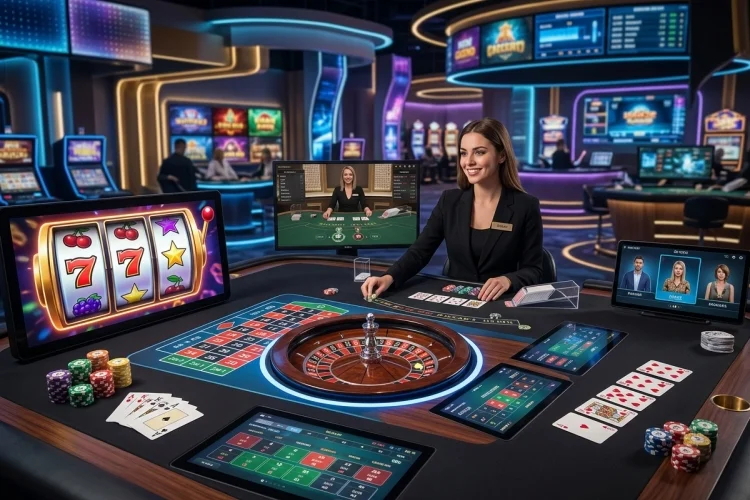

When you open an online casino, it may look like the casino itself created every slot, table game, and live dealer room on the website. In reality, that is rarely how the industry works.
So, What Is a Casino Game Provider? Put simply, it is a company that develops and supplies gambling games or related gaming software to casino operators.
These providers sit behind much of what players actually see on the screen, from game mathematics and graphics to live studios, mobile compatibility, and technical integration.
Understanding their role makes the online casino ecosystem much easier to understand.
What Does a Casino Game Provider Actually Do?
A casino game provider is essentially a specialist software supplier.
Instead of operating the entire casino website, the company focuses on creating the games that appear inside it. That may include online slots, roulette, blackjack, baccarat, video poker, virtual games, or live dealer products.
In regulated markets, software supply can itself be a licensed activity. The Malta Gaming Authority, for example, describes the supply and management of software or material game elements as a form of critical gaming supply that can require a B2B licence.
This distinction matters because the company creating the game and the company accepting the player’s deposit may be completely different businesses.
Providers Design the Game Mechanics
Creating a casino game involves far more than drawing symbols and adding background music.
Developers need to decide how the game works mathematically. For a slot, this can involve reel structures, paylines or ways-to-win systems, bonus features, volatility, prize distributions, and return-to-player calculations.
A design team then combines that mathematical model with animations, sound effects, themes, user-interface elements, and mobile controls.
The result has to feel entertaining while still operating according to its underlying rules. A visually impressive slot with confusing mechanics can still provide a poor user experiance.
This is why good providers usually combine mathematics, software engineering, design, and compliance expertise rather than relying on only one discipline.
Random Number Generators Are a Major Part of Digital Games
Most digital casino games rely on some form of random number generation.
The RNG is responsible for producing outcomes according to the game’s programmed mathematical model. It does not simply choose results based on whether a player has recently won or lost.
For regulated British gambling software, the UK Gambling Commission states that random outcomes must be acceptably random and capable of being demonstrated through recognised statistical testing. It also prohibits adaptive behaviour that changes game probabilities during play.
That means RNG development is not just a creative feature. It is also a major technical and regulatory responsibility.
Independent laboratories may examine RNG behaviour, game mathematics, and RTP calculations before software enters particular regulated markets.
eCOGRA, for example, lists RNG-driven games, random number generators, platforms, and other gambling systems within its certification scope.
Providers Also Build Live Casino Games
Not every provider specialises in software-generated slots.
Some companies operate large live casino studios containing real tables, cameras, presenters, lighting systems, game-control technology, and streaming infrastructure.
Players then participate remotely through a casino website while the physical game takes place in the studio.
Evolution is a good example of this provider model. Its portfolio includes live roulette, blackjack, baccarat, game shows, RNG-based products, and slots across several brands.
Running this type of product requires a very different techncial setup from building an ordinary digital slot. The provider must manage video production, latency, physical equipment, game integrity, studio staff, and real-time communication with casino platforms.
How Games Reach an Online Casino
Once a game exists, it still has to be connected to casino operators.
Providers normally make their products available through technical integrations. Instead of a casino rebuilding every game itself, it connects its platform to the supplier’s gaming infrastructure.
Some suppliers package multiple product categories through one integration. Pragmatic Play, for example, promotes access to products including slots and live casino through a single API.
Other operators work with aggregators.
An aggregator acts as a middle layer between casinos and numerous providers, allowing an operator to access many game studios through fewer integrations. This can make it easier to build a large game catalogue without creating a seperate connection for every studio.
For the player, all of this usually happens invisibly. The games simply appear inside the casino lobby.
Game Providers Are Different From Casino Operators
The difference between a provider and an operator is one of the easiest industry concepts to confuse.
The provider develops or supplies the gaming product. The casino operator manages the customer-facing gambling service.
Depending on the market and business model, the operator may handle account registration, identity verification, deposits, withdrawals, customer support, bonuses, responsible gambling tools, and regulatory reporting.
The provider may never directly hold the player’s casino account.
This separation also explains why the same slot can appear at several unrelated casino websites. Multiple operators may have commercial agreements allowing them to offer content from the same studio.
Testing and Certification Matter Before Games Go Live
Regulated casino software cannot always be released immediately after development.
In Great Britain, gambling software made available under a Gambling Commission operating licence must meet the regulator’s remote gambling and software technical standards and be tested according to the relevant testing strategy.
Testing can cover areas such as RNG performance, game rules, result determination, security, and other regulated functions.
Independent companies such as GLI and eCOGRA provide testing and certification services for gaming suppliers and operators. GLI’s iGaming services include game testing, RNG testing, RTP assessment, platform testing, and live dealer evaluation.
Certification does not mean players will win more often. It is about checking whether the product operates according to applicable rules and technical requirements.
Why the Provider Name Matters to Players
Players do not need to become software experts, but knowing the provider can still be useful.
Different studios often develop recognisable design styles. One may focus on high-volatility slots, while another may prefer simpler mechanics or live casino products.
Provider information can also help players locate official game rules, RTP details, or similar titles from the same developer.
More importantly, the studio behind a game is only one part of the evaluation. Players should still consider the casino’s licence, payment rules, withdrawal policies, customer support, and responsible gambling protections.
A respected provider does not automatically make every casino offering its games equally trustworthy.
Understanding What Is a Casino Game Provider? reveals how much specialised work sits behind an online casino lobby.
Providers develop mathematics, software, graphics, RNG systems, live studios, and integrations before games reach players.
Next time you browse a casino, check who created the games rather than looking only at their titles. The provider can tell you a lot about the technology and style behind the experience.