Live casino technology must accomplish two goals at the same time. It must create an entertaining video experience, but it must also preserve accurate, reviewable records of every wager and physical game result.
The technology behind live casino streaming therefore includes more than cameras and internet video.
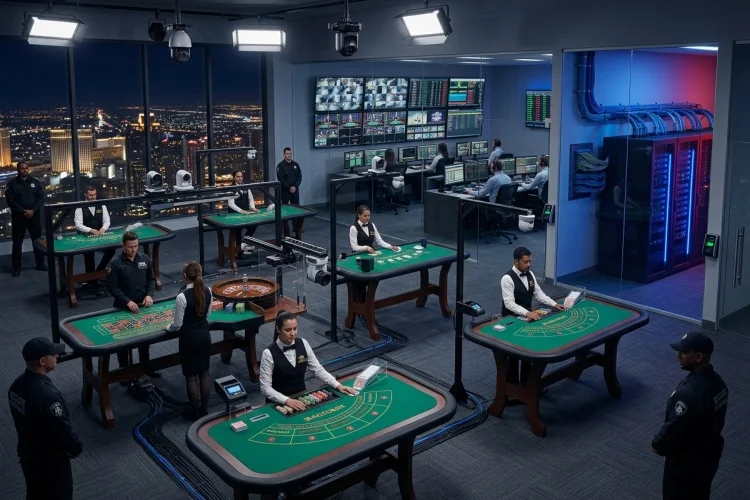
Secure studios use controlled equipment, trained dealers, surveillance, recognition systems, access restrictions, game databases, and player-account platforms. These components create a chain connecting the physical table to the final balance update.
A trustworthy system should show that the displayed cards or roulette result match the event that occurred in the studio. It should also prove when a wager was placed, whether it was accepted, and how the payout was calculated.
Technology cannot remove the mathematical house advantage or guarantee player winnings. Its role is to help ensure that published rules are followed consistently and that unusual incidents can be investigated using reliable evidence.
Secure Studio Operations
The first security layer is the physical studio. Access to tables, cards, shoes, roulette wheels, recognition devices, and monitoring systems should be restricted to authorized staff.
Dealers need documented training, while supervisors monitor procedures and equipment. Cameras record the table closely enough to review disputed actions.
The UK Gambling Commission’s live dealer standards call for commercial-quality equipment, dealer training, responsible supervisory staff, secure access, surveillance, and auditable records.
Capturing an Authoritative Result
In traditional live blackjack, baccarat, and roulette, the official result begins with a physical event. A card is dealt or a ball enters a numbered wheel pocket.
Recognition equipment translates that event into data. OCR may identify printed card values, while sensors or specialized systems can capture roulette results.
GLI explains that live dealer platforms convert physical transactions into data that the game software can process. It also distinguishes these outcomes from those generated automatically by an RNG in conventional digital casino games.
Protecting Data in Transit
The video feed, player commands, and account information travel over internet connections. These channels should be protected against unauthorized interception or alteration.
Media technologies can support encryption and controlled access. Apple’s HLS architecture, for example, includes support for encrypted media delivery, while streaming platforms may use signed or tokenized URLs to prevent unauthorized viewing.
Account information requires additional safeguards. Login security, session controls, encrypted connections, and payment protections operate separately from the video itself.
Synchronization as a Fairness Control
A live game must prevent players from betting after an outcome becomes visible. The platform therefore relies on synchronized betting deadlines and server-side timestamps.
The dealer may announce that bets are closed, while the software independently stops accepting commands. The table event, OCR record, video timeline, and settlement data must identify the same round.
GLI’s testing process includes synchronicity and technical evaluations of live dealer systems. These checks help determine whether the player interface corresponds correctly with the real-world action.
Audit Logs and Recorded Evidence
Every round can generate several records: the accepted bets, account balance before and after settlement, table identifier, timestamp, recognized result, and video footage.
These records allow operators to investigate complaints. They may also reveal unusual dealer behavior, equipment problems, repeated recognition errors, or suspicious betting patterns.
Regulatory guidance expects live dealer studios to preserve video and game logs in a form that supports independent auditing. Statistical reports may also be used to identify abnormal trends involving tables, employees, or locations.
Independent Testing and Inspection
Testing can occur remotely and inside the studio. Remote evaluation examines the player interface, account functions, location controls, reporting, and game settlement.
On-site inspection can review premises, staffing, equipment, physical security, shuffling procedures, wheel operation, and surveillance. GLI lists responsibility, technical, synchronization, staffing, premises, and system testing among its live dealer services.
The UK Gambling Commission may require an audit when another relevant jurisdictional assessment does not sufficiently cover its live dealer requirements.
Managing Errors and Disconnections
Even a secure system can experience human or technical errors. A card may be scanned incorrectly, the stream may freeze, or the network may disconnect after a wager is accepted.
Documented procedures determine whether the round continues, is corrected, or becomes void. Supervisors can compare the physical table, recognition data, video recording, and server logs.
Players should record the table name, round number, wager, and time when reporting a problem. The official transaction history is generally more reliable than a screenshot showing a delayed local video frame.
What Players Should Verify
Players should confirm the operator’s licence using the relevant regulator’s official register. They should also identify the live game provider and read the exact table rules.
The game information should explain betting limits, payout values, side wagers, interruption procedures, and how disputed rounds are reviewed. Missing ownership or licensing information is a serious warning sign.
A secure technical system does not make gambling profitable. Players should still use deposit limits, session reminders, time-outs, or self-exclusion whenever required.
Security in live casino streaming comes from several connected controls. Restricted studios protect physical equipment, OCR translates real-world results, encrypted communication protects data, and synchronized servers connect every accepted bet to the correct round.
Surveillance, transaction histories, and audit logs make the operation reviewable after an error or complaint. Independent laboratories and regulators then evaluate whether the physical and digital components follow documented standards.
Before playing, verify the licence, provider, table rules, and dispute procedure rather than relying only on the appearance of the video.
Use an affordable entertainment budget, retain transaction records when necessary, and leave any platform that cannot explain how it protects results and player data.